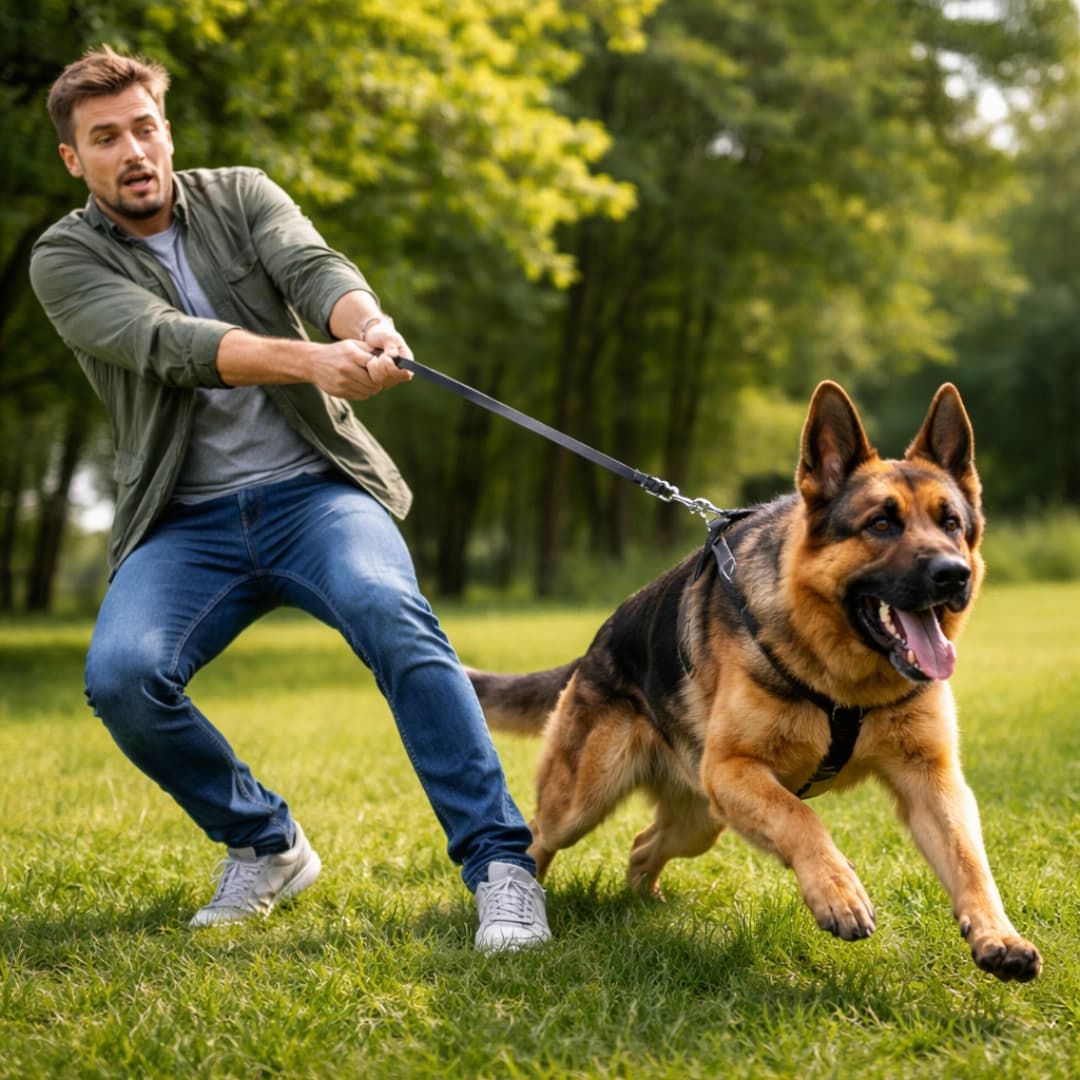
Your shoulder is sore, your dog is coughing at the end of the leash, and a ten-minute walk feels like a workout. Leash pulling is the single most common complaint we hear from Montreal dog owners — more than barking, more than jumping, more than anything else.
Here is the good news: pulling is not a character flaw, and your dog is not trying to be the boss. It is a learned behaviour with a clear mechanical explanation — which means it can be un-learned with the right structure.
Our trainers coach loose-leash walking every week, at our Anjou facility and on real sidewalks across Montreal, Laval, and the West Island. This article covers why your dog pulls, why the usual fixes disappoint, and what actually changes the walk.
Why your dog pulls: because pulling works
Dogs repeat what pays off. Every time your dog pulls and the walk keeps moving forward — toward the park, the hydrant, the interesting smell — pulling gets reinforced. From the dog's point of view, tension in the leash is simply how you get places. Thousands of walks have taught exactly that lesson.
A few other ingredients stack on top of that reinforcement history:
- The opposition reflex — dogs naturally push against steady pressure. A tight leash triggers a reflexive lean into the collar or harness, so the more you haul back, the harder your dog drives forward.
- Arousal and excitement — a dog that explodes out the front door with a full tank of energy walks on adrenaline, not brain. Excited dogs pull harder and hear you less.
- Speed mismatch — a comfortable trot for most dogs is faster than a comfortable human walking pace. Without training, your dog has no reason to match your speed.
- An environment that is too hard — smells, squirrels, other dogs, traffic. If the street is more interesting than you are, the street wins.
Why gear swaps and leash pops fall short
Most owners try equipment first: a new harness, a different collar, a shorter leash. Some tools genuinely reduce pulling and make a dog easier to handle — that is useful management, and we use it. But equipment changes what pulling feels like; it does not teach your dog what to do instead. Take the tool off, and the pulling comes right back.
Yank-and-correct approaches have the opposite problem. Repeated leash pops can suppress pulling in the moment while adding conflict to the walk — and with the opposition reflex in play, steady tugging usually makes a determined puller lean in harder. Meanwhile, the dog still has no idea where you actually want it to be.
Retractable leashes deserve their own mention: they reward pulling by design. The dog pulls, the line pays out, the dog gets farther. If loose-leash walking is the goal, a fixed-length leash is non-negotiable.
What structured loose-leash training looks like
At Montreal Canine Training, leash work starts with an evaluation. We watch how your dog moves, what it pulls toward, what equipment you use, and how you handle the leash — before changing anything else. From there, the training follows a clear progression:
- Engagement first — before the walk gets fixed, the dog has to learn that checking in with you pays. This starts indoors and in quiet spaces, not on the busiest sidewalk.
- Reinforcement position — we reward the dog heavily for being at your side, so the position itself becomes valuable. Where the reinforcement happens is where the dog wants to be.
- Clear rules about tension — forward movement happens on a loose leash; tension makes progress stop. Consistency is what makes the rule readable to the dog.
- Graduated environments — a quiet street before a commercial artery, then progressively busier blocks. Each level is added only when the previous one is solid.
Progress looks like this: a faster recovery when the leash goes tight, more spontaneous check-ins, longer stretches of slack. It is built through weeks of consistent repetitions, not one revelation walk.
Leash walking in Montreal is its own sport
Loose-leash walking is harder here than in a suburb with wide, empty sidewalks. Montreal's narrow sidewalks force close passes with dogs, strollers, and pedestrians. Triplex staircases spill directly onto the walkway, so surprises appear at zero distance. Busy crosswalks demand a dog that can wait calmly beside you instead of straining at the curb.
Winter raises the stakes. On icy sidewalks, a strong puller is not just annoying — it is a genuine safety problem. One hard surge on a frozen crosswalk can put you on the ground. Salt and slush make some dogs dance and dart toward snowbanks. A dog that learns to walk on a slack leash before December is a dog you can safely walk in February.
We build training plans around this reality: your actual routes, your neighbourhood's traffic, and the seasons you walk in.
When pulling is a symptom of something bigger
Some pulling is not about the walk at all. If your dog pulls mostly toward — or away from — other dogs, and the pulling comes with barking, lunging, whining, or freezing, you may be looking at leash reactivity rather than a simple manners problem. The distinction matters, because reactivity needs threshold and exposure work, not just position training.
This is one of the things the evaluation sorts out. Plenty of dogs arrive labelled as pullers and leave with a reactivity plan — and plenty of dogs feared to be reactive turn out to be strong, excited pullers who simply need structure. Our dedicated reactive dog training program exists for the first group; loose-leash coaching handles the second.
How long does leash training take?
It depends on your dog's age, how many years pulling has been rehearsed, your consistency between sessions, and where you walk. A young dog with a short pulling history in a quiet neighbourhood progresses very differently from a five-year-old who has pulled down busy commercial streets its whole life.
What we can say honestly: most owners see the trajectory change quickly once the rules become consistent — and the polished result, a dog that holds a loose leash past real distractions, is measured in weeks to months of practice, not days. Anyone promising a fixed number of sessions before meeting your dog is guessing.
The walk you want is a skill — yours and your dog's. Built properly, it lasts.