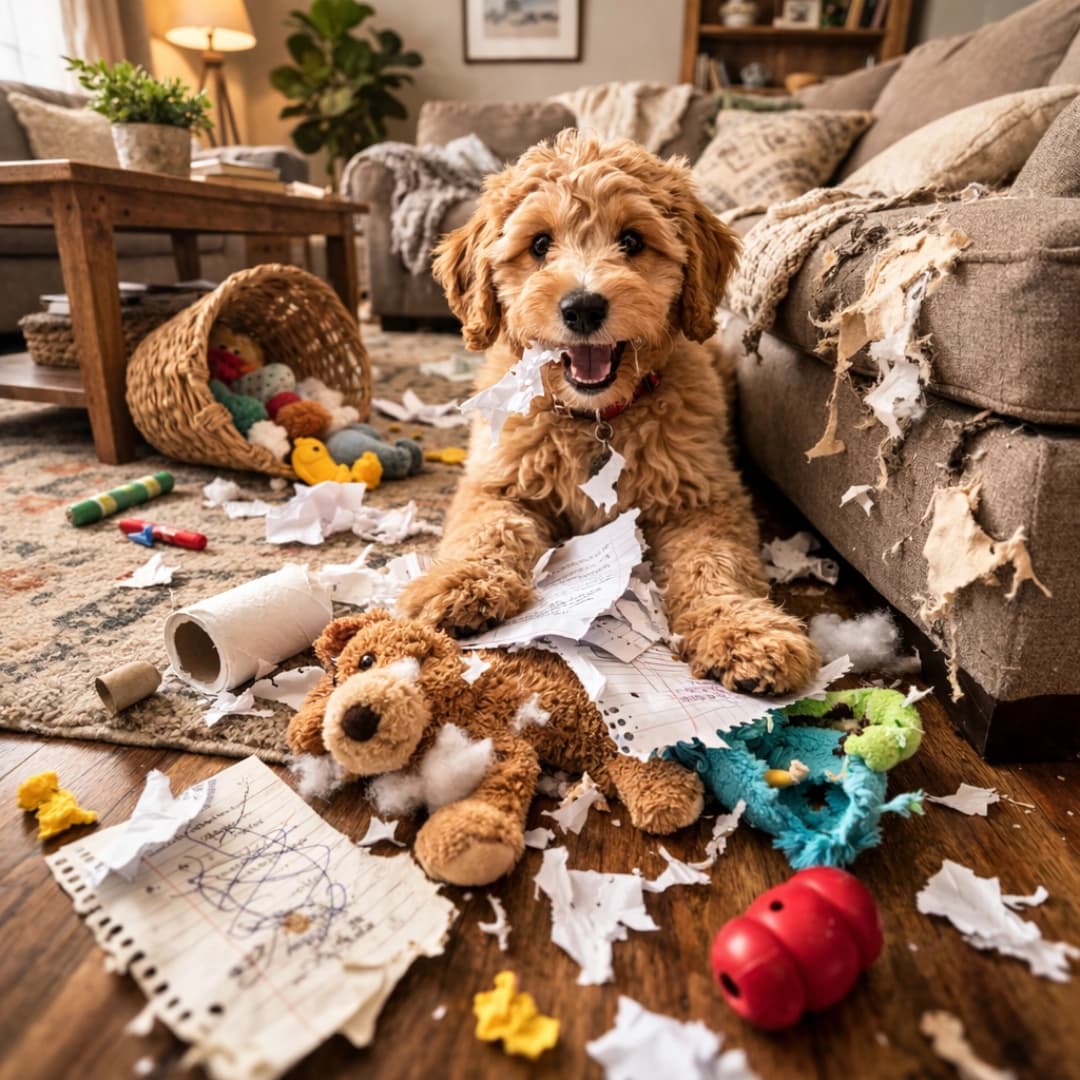
You close the door, and your dog falls apart. Maybe the neighbours in your triplex have started mentioning the howling. Maybe you come home to scratch marks on the door frame or a shredded blind by the front window.
Separation anxiety is one of the most misunderstood problems we see at our Anjou training centre. Owners often wait months before asking for help, partly because well-meaning advice — "let him cry it out," "get a second dog" — keeps pointing them in the wrong direction. Here is what real separation anxiety looks like, the myths that keep dogs stuck, and the kind of gradual work that actually moves the needle.
The real signs of separation anxiety
Separation anxiety is not misbehaviour. It is panic — a dog who genuinely cannot cope with being left alone. The signs usually appear within the first few minutes after you leave and follow a consistent pattern:
- Vocalizing that does not stop — barking, whining, or howling that continues long after you have gone, not a few protest barks that fade
- Destruction focused on exit points — door frames, window sills, blinds, the crate itself — rather than random chewing
- Pacing, drooling, panting, or trembling that starts while you are getting ready to leave
- Refusing food when alone — a stuffed Kong ignored until the moment you walk back in
- Frantic, over-the-top greetings after even short absences
The location and timing of the behaviour tell you more than the behaviour itself. A stolen shoe in the middle of the living room tells a very different story than claw marks on the back of the front door.
Anxiety or boredom? The camera test
Plenty of dogs destroy things because they are under-exercised, going through adolescence, or simply left with nothing to do. Boredom looks bad, but it is not panic — and the two problems need different plans.
Before assuming anything, run the camera test. Set up your phone or an inexpensive camera pointed at the door and your dog's main resting spot, leave the way you normally do, and watch the first 20 to 30 minutes.
- A bored dog typically settles, naps, and gets into mischief later — and he usually eats the food you left behind
- An anxious dog escalates fast: pacing within minutes, vocalizing at the door, ignoring food entirely, never settling at all
That footage is some of the most useful information you can bring to a trainer. It shows how quickly stress appears and how intense it gets — which is exactly what a training plan gets built around.
Four myths that keep dogs stuck
Myth 1: "He's punishing me for leaving"
Dogs do not destroy your couch out of spite. The guilty look when you come home is a reaction to your body language, not a confession. What looks like revenge is a dog who spent the afternoon in distress.
Myth 2: "A second dog will fix it"
Separation anxiety is usually about your absence, not about being alone in general. Many anxious dogs panic just as hard with another dog in the room — and now you may have two dogs rehearsing stress instead of one.
Myth 3: "Just let him cry it out"
For a dog in genuine panic, crying it out means rehearsing panic. Every departure that pushes him over his threshold strengthens the link between you leaving and something unbearable happening. Most dogs do not habituate this way — they get worse, or they shut down.
Myth 4: "A crate solves everything"
Crates are a useful tool for many dogs, but some anxious dogs panic harder in confinement — damaged teeth and injured paws from escape attempts are not rare in serious cases. Crate, pen, gated room, or free run of the home: the right setup depends on the dog in front of you, not on a rule.
Why gradual departures work — and how long it takes
The approach that consistently helps is threshold-based training: finding the amount of alone time your dog can currently handle without panicking — even if that is thirty seconds — and building from there in small, measurable steps.
In practice, that means many short, boring departures: stepping out, coming back before stress starts, then gradually adding duration and realistic cues like keys, coat, and boots. The goal is to make your exits so predictable and uneventful that they stop meaning anything.
Be honest with yourself about the timeline. Real progress is measured in weeks and months, not days. Dogs who start at two minutes of calm alone time and work up to a full workday absence exist — but they got there through consistent, gradual repetitions, not a gadget or a weekend fix.
What makes separation anxiety worse
Some common habits quietly feed the problem:
- Dramatic exits and greetings — long emotional goodbyes and euphoric reunions teach your dog that departures are a very big deal
- Pushing duration too fast — one four-hour absence can undo weeks of careful thirty-second repetitions
- Punishing the mess after the fact — your dog cannot connect the scolding to something that happened hours ago, so it only adds anxiety to your returns
- Only leaving when you have to — if every departure is a real, long one, your dog never gets easy repetitions to practise on
- Unpredictable routines — dogs cope better when meals, walks, and rest follow a rhythm they can count on
Montreal winters add a wrinkle: when it is -20 outside and walks get shorter, an under-exercised dog has a harder time settling. A solid physical and mental outlet before you leave is not a cure, but it stacks the odds in your favour.
When to get structured help
If your dog is hurting himself, if the neighbours are complaining, if you have stopped leaving the house — or if weeks of your own gradual work have not moved the needle — it is time for a structured plan.
Our separation anxiety training starts the way every behaviour case does: with an evaluation. We review your camera footage, map your dog's current threshold, look at your home setup and daily routine, and build a step-by-step plan you can actually run between sessions. Because this problem lives at home, in-home sessions are often part of the plan.
Separation anxiety is one of the hardest problems to live with, because it follows you out the door. It is also one where a clear, honest plan makes the biggest difference — for the dog, and for the people who love him.