Your dog spots another dog across the street. Ears forward, body stiff, and then the explosion — barking, lunging, spinning at the end of the leash. Meanwhile you are apologizing to strangers and wondering what you did wrong.
Here is the part most owners never get told: reactivity is rarely about dominance, stubbornness, or a "bad" dog. In most cases, it is communication. Your dog is using the loudest tool it has to say one thing — "I need more space."
Our trainers work with reactive dogs every week in Montreal, in private sessions and in dedicated reactivity group classes. This article explains what reactivity actually is, why it happens, and what genuinely helps.
What reactivity looks like — and how it differs from aggression
Reactivity is an overreaction to a normal trigger — usually another dog, a stranger, a bike, or a skateboard. The dog goes from calm to overwhelmed in seconds and cannot respond to cues it knows perfectly well at home.
- Barking, lunging, or spinning at the end of the leash
- Whining, pacing, or fixating the moment a trigger appears
- Hackles up, stiff body, hard staring before the outburst
- Grabbing the leash or redirecting on the handler out of frustration
- Complete inability to take treats or hear you once triggered
Aggression is different in intent. An aggressive dog is trying to make contact — to bite, to drive away a threat, to guard a resource. A reactive dog is mostly trying to increase distance or, in frustration cases, to close it because the leash will not let it say hello. The two can look similar from the outside, which is exactly why an in-person evaluation matters before choosing a training plan.
The real drivers: fear and frustration, not dominance
Most reactive dogs fall into two broad groups. Fear-based reactive dogs bark and lunge to make the trigger leave. Every time the other dog walks away — which it always eventually does — the display gets rewarded, and the pattern gets stronger.
Frustration-based reactive dogs are often friendly off leash. On leash, they cannot reach the thing they want, and that blocked excitement boils over into barking and pulling. Owners are often confused because their dog "loves other dogs at the park" but looks furious on the sidewalk.
What is almost never the cause is dominance. A dog screaming at the end of a leash is not plotting to run your household; it is past its emotional threshold and physically unable to think. Labels like "dominant" or "stubborn" push owners toward confrontation — exactly the wrong direction.
Why punishment backfires — and why avoidance alone does not fix it
Punishing the display can suppress the barking without changing the emotion underneath. The dog learns that other dogs predict corrections, which can make the underlying fear worse — and a dog that stops warning before it reacts becomes harder to read, not safer.
The opposite extreme has the same problem. Walking at 5 a.m., crossing the street at every encounter, and avoiding every trigger keeps everyone calm, but the dog never learns a new response. Avoidance is excellent short-term management; it is just not training.
Real progress needs both: management to stop the dog from rehearsing the explosion every day, and structured training to teach a different answer to the trigger.
Thresholds: why Montreal streets make reactivity harder
Every reactive dog has a threshold — the distance at which it can notice a trigger and still think, eat, and respond to you. Under threshold, learning is possible. Over it, nothing you say lands.
Montreal is genuinely hard mode for threshold work. Narrow sidewalks, winding triplex stairwells, and tight alley corners mean dogs appear at close range with no warning. Add icy winter sidewalks where you cannot move away quickly, busy commercial streets, and neighbourhoods full of dog parks, and many dogs spend entire walks over threshold.
That is not an excuse — it is planning information. Knowing your dog's current threshold tells you which streets, times of day, and setups make training possible instead of just survivable.
What structured reactivity work actually looks like
At Montreal Canine Training, reactivity cases start with an evaluation. We watch how your dog responds, at what distance, to which triggers — and we look at your leash handling, your equipment, and your usual routes before changing anything else.
From there, the work follows a clear order:
- Management first — routes, equipment, and spacing rules that stop the daily rehearsal
- Engagement — teaching the dog that checking in with you pays off, starting in easy environments
- Controlled exposure — working around real triggers at a distance the dog can handle, then closing that distance gradually
- Real-world proofing — sidewalks, entrances, park perimeters: the places where the problem actually lives
Progress is measured in details: a dog that notices a trigger and then looks back at you, a faster recovery after a startle, a fence line passed without a scene. Reactivity work is rarely dramatic — it is a series of small, repeatable wins.
Group class or private training — which fits your dog?
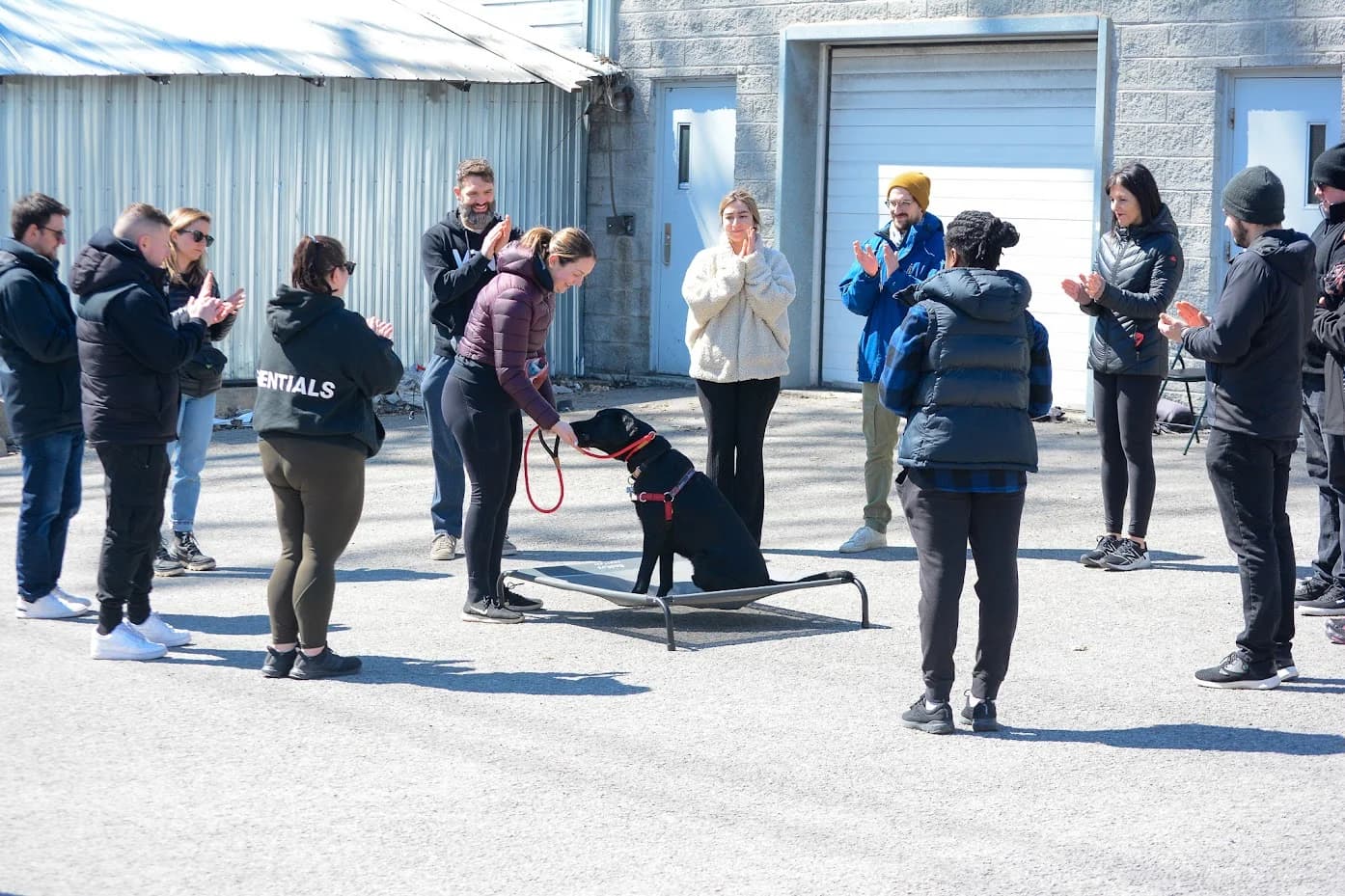
Our reactivity group classes are built specifically for reactive dogs: structured setups, controlled distances, and gradual exposure around other reactive dogs, with handlers who understand what you are dealing with. They fit dogs that can function near triggers at some distance and owners who want realistic but managed practice.
Private training fits dogs that go over threshold the moment they see a trigger, dogs with a bite history or aggression concerns, and owners who want to build handling fundamentals before adding pressure. Many dogs do both — private sessions first, then a group class as the graduation step.
If you are not sure which one fits, that is exactly what the evaluation is for. Every reactivity case we take starts there — with your dog, your triggers, and a plan built for your actual neighbourhood.